

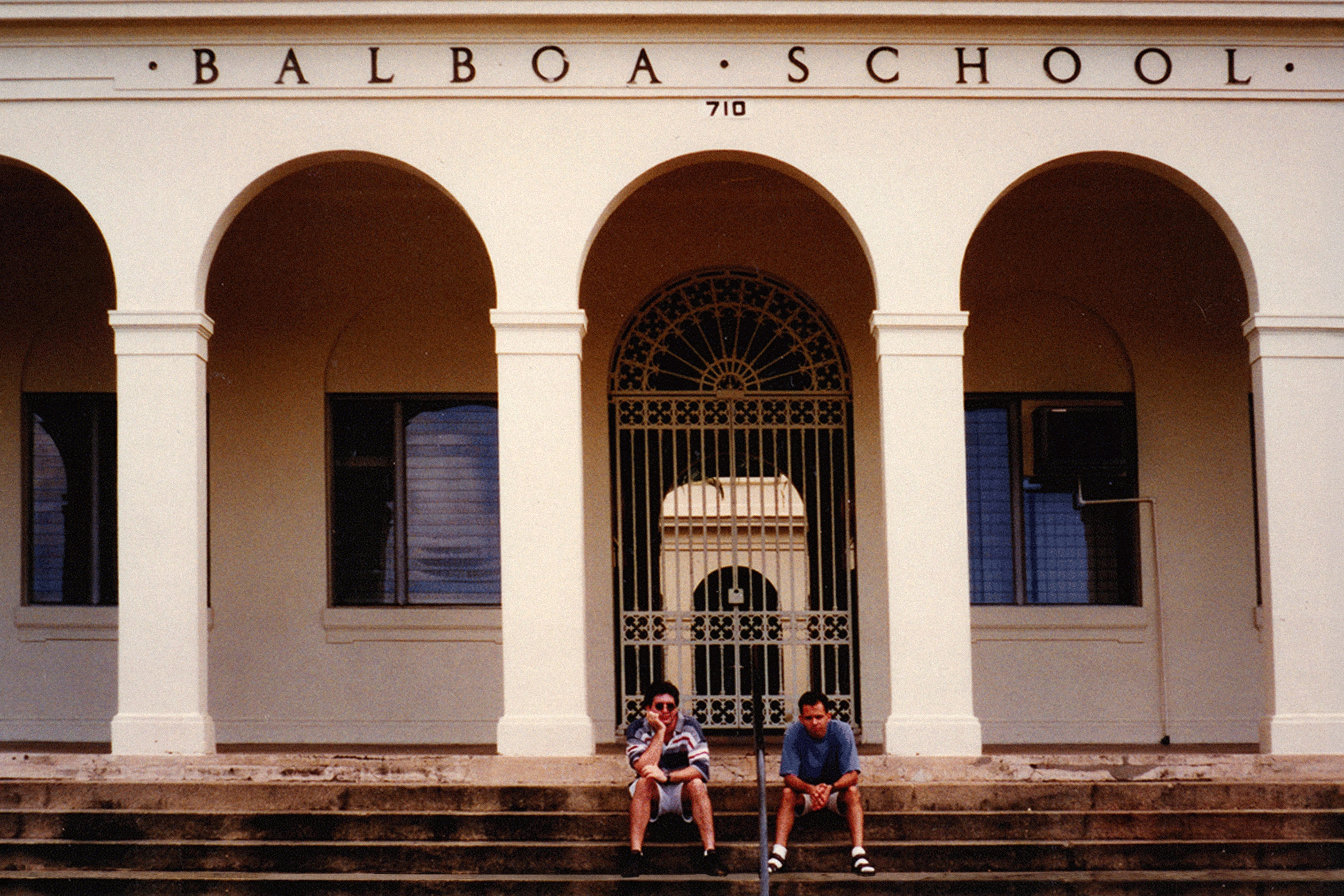
For almost a decade, I walked those 113 steps — up and down Ancon Hill, past the Admin building, on my way to Balboa Elementary, then Balboa High, or just out venturing toward El Prado, Steven's Circle, the arcades, the pool. Some days it was a commute. Most days it was an adventure. Either way, it's the walk I keep coming back to when I think about what this project is really trying to hold onto.
I spent my foundational years up on Quarry Heights, went through Balboa Elementary, Curundu Junior High, and Balboa High School — though I had to leave after 11th grade. My bilingual Idahoan father was Military Intelligence at SouthCom, though you may have thought of him as from elsewhere due to his vast exposure to many other countries. My Argentine mother probably never imagined that she’d travel so much after leaving Buenos Aires in her mid-twenties. She worked at the PX in Corozal. Life up on the hill was an adventure for me and my siblings—David, Mitchell and Shireen—beautiful, dense jungle with a quarry scar rising as a beacon. Almost a decade on the isthmus became my regular and I had believed for a good portion of my life that all had such unique experiences. I learned that I had to narrow that down to Zonians that carried a similar story. I’ve been an artist for as long as I can remember. That path eventually led to an MFA in Film Directing and a BFA in Illustration from ArtCenter College of Design in Pasadena, California, and an AS in Graphic Design from BYU-Idaho in a small college town of Rexburg. And it's not typical for one person to move across film, photography, art / illustration, entertainment design, and being an art college educator across all those industries. Most people I trained alongside picked one, maybe two and stayed. Mine came out of necessity: deep challenges within my family meant I kept having to adapt, and each shift pushed me into a new discipline. I came close to a spot at DreamWorks along the way. That range is what I've brought to this documentary: taking the everyday texture of a Zonian and giving it the weight of a National Geographic frame.
What follows are a few voices from that tropical world; people who shared the hill, the jungle, the classrooms, and in one case, watched all of it from just outside the fence. Here's what they had to say about who I was then, and what I'm trying to do now.
Raymond Samuels
There are certain places in the world that never truly leave your heart, and for those of us who grew up in the Canal Zone, those memories become part of who we are. I was fortunate to share many of those unforgettable years with my lifelong friend, Thayne.
Our friendship began in the fifth grade at Balboa Elementary School. We continued through Curundu Junior High and Balboa High School, and have remained close friends ever since. Looking back, it’s easy to see that Thayne was always a dreamer, an explorer, and an artist at heart.
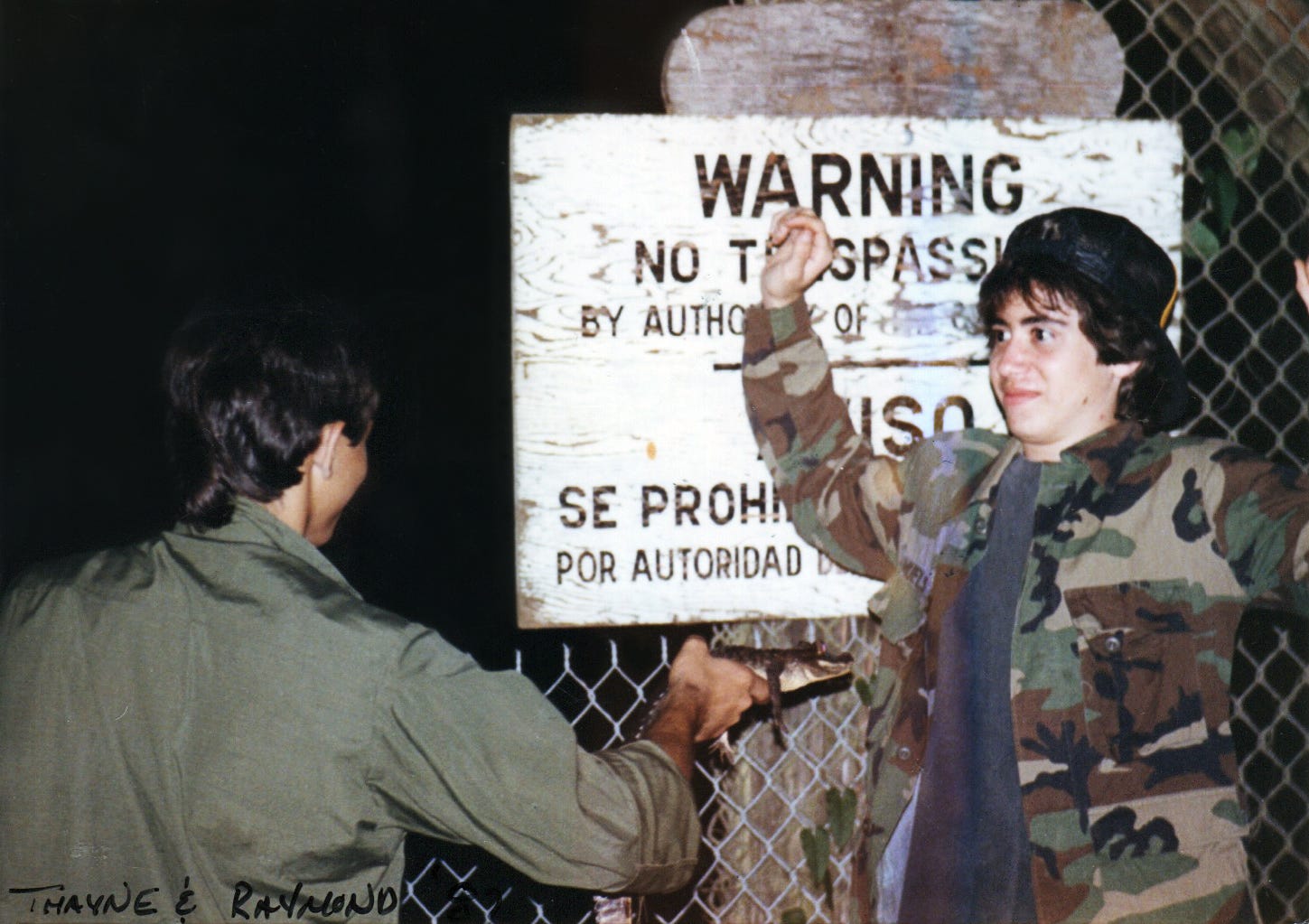
We spent countless days creating adventures that only kids growing up in the Canal Zone could experience. We explored the jungles surrounding Quarry Heights, enjoyed countless slices of Napoli pizza, wandered everywhere from Steven’s Circle to Gorgas Hospital and up Ancon Hill, and even paddled canoes across Gatun Lake late at night, shining flashlights into the darkness in hopes of spotting crocodiles. Those adventures weren’t just moments in time—they became stories that have stayed with us for a lifetime.
Anyone who had the privilege of growing up in the Canal Zone carries those memories with them forever. They are woven into our friendships, our families, and our identities.
Thayne has never lost the curiosity and creativity that defined him as a young boy. While continuing his journey as an accomplished artist, he has also expanded his talents into the film industry. Today, he has embraced an even greater calling: preserving the history, stories, and memories of the Canal Zone and the people whose lives were shaped there.
I cannot think of anyone more passionate or better suited to serve as a curator of these treasured memories. Thayne understands that history is more than dates and photographs—it is the collection of personal stories that connect generations. Through his dedication, future generations will have the opportunity to experience the spirit of a place that meant so much to so many.
Thank you, Thayne, for ensuring that the legacy of the Canal Zone lives on. Your enthusiasm, vision, and commitment are preserving not only history, but also the memories, friendships, and adventures that continue to inspire all of us who were fortunate enough to call the Canal Zone home.
Raymond and I first met in Mr. Green’s 5th grade class at Balboa Elementary. If I recall, he lived in La Boca at the time.
Kathy was a couple years olds and we were neighbors up on Quarry Heights’ Upper Level in a three-story quarters building—number 26, split into four units with ground level given over to the carports — she lived in B and I in D unit.
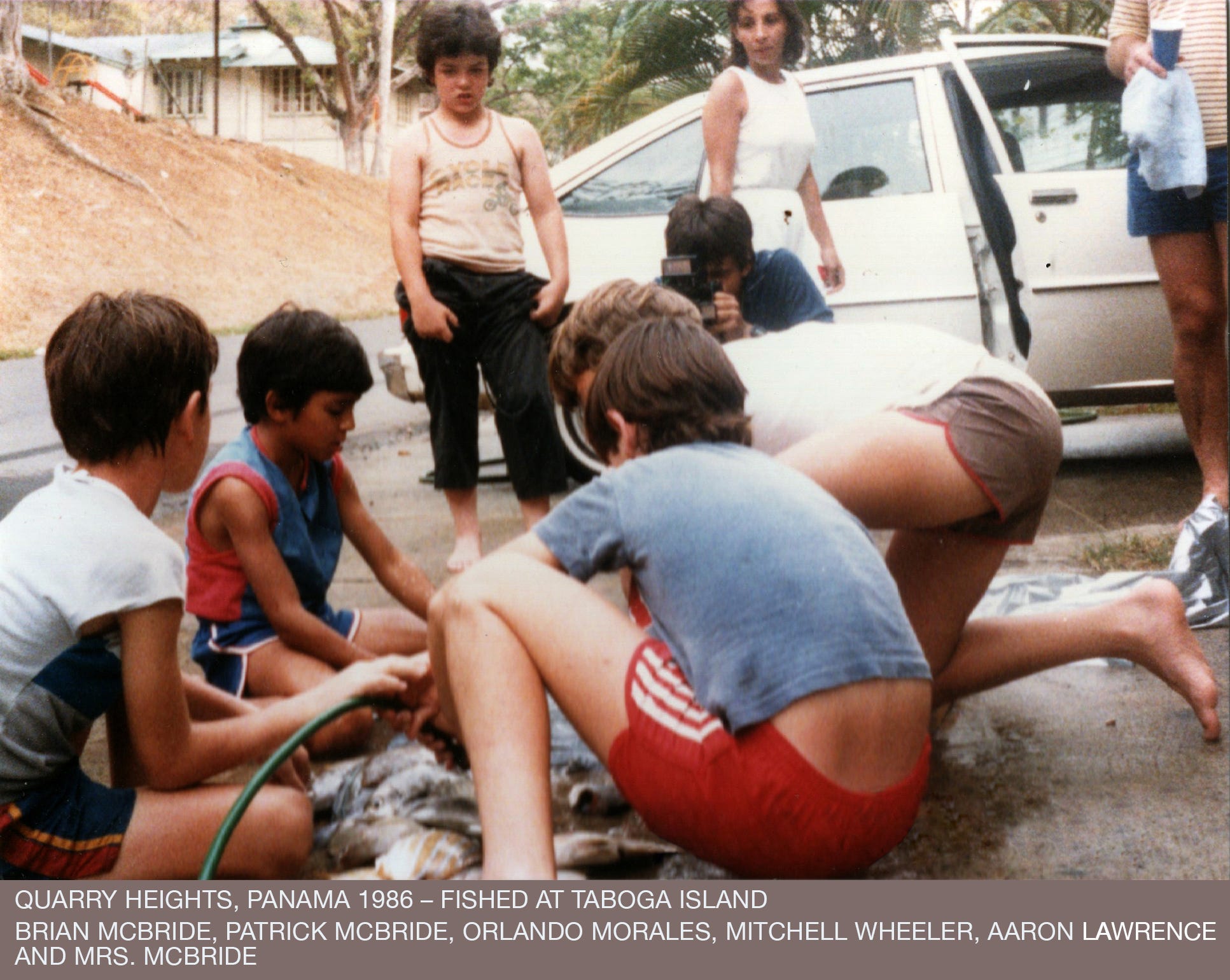
All us kids would be off on adventures into the jungle, sliding down the Admin hill, bikes and skateboards, out fishing on the Causeway or the pier at Taboga.
Kathy Morales-Estrada
Looking back, we didn’t realize it then – but as children, our minds couldn’t grasp the paradise we were blessed to share. Quarry Heights; a tiny post nestled in the jungle-covered summit of Cerro Ancón, the freedom to explore, and the friendships that shaped us – those were the treasures of our childhood. Thayne, always present, led the way for the neighborhood kids. He took my little brother and all the other kids under his wing, teaching them of the wonders of the jungle, its animals that we often shared space with and the joy of fishing. They’d come home with enough fish to feed the neighborhood, glowing with a kind of happiness that only comes from days well spent in nature and friendship.
David Dahlstrom (Canal Zone Historian)
A picture is worth a thousand words. Anyone can share a photograph, but Zonians provide the meaning behind those images. Their memories preserve one of the most unique American communities ever established outside the United States. Unless these stories are collected now, many will be lost as the generation that lived them passes into history.
History is most powerful when told by those who experienced it. The Canal Zone Documentary is more than a film—it is a community preservation effort that depends on Zonian voices. Their contributions bring authenticity and a collective perspective that no outside production can replicate, ensuring these memories are preserved for future generations.
The Canal Zone can no longer speak for itself, but its people can. Every story, photograph, and memory shared strengthens this effort and helps ensure future generations understand not only what the Canal Zone was, but what it meant to those who called it home.
I strongly endorse the Canal Zone Documentary as a vital effort to preserve the history and legacy of the Canal Zone community. This is a critical moment—without active participation, these stories will be lost. I urge all Zonians to contribute their memories, photographs, and records now to ensure this history is preserved with accuracy, depth, and authenticity for generations to come.
Julissa Brown-Craven
Looking back on my childhood in Panama, I can still feel the warm, tropical air, and hear the rain tapping on palm tree leaves during the rainy season. Life felt slower and simpler, but every day held a bit of adventure.
One of the most vivid memories I carry with me is from the fifth grade, when I had a good fortune of sharing a classroom and a lot of laughs — with Thayne Wheeler. Whether we were racing each other during recess or coming up with ridiculous inside jokes, there was never a dull moment. We were Mr. Green’s class, a teacher who had a way of making even the most boring subjects fun.
Even now, I go back to Panama every year to visit my family. Walking by the old school, hearing the familiar sounds, smelling the same foods — it’s like no time has passed. Being there, reminds me of who I was back then: a curious kid, with a great teacher, a good friend, and memories that still make me smile.
Todd Underwood
Growing up with Thayne in Panama was an incredible experience. Balboa elementary, the playground included the jungle leading up to the Quarry Heights at the base of Ancon Hill. We had a fantastic steel slide that we go wicked fast. We played steal the bacon, climb ropes and played with parachutes during PE. We always had presidential fitness awards to achieve. We raced our hot wheels in the gutters along the Administration Building steps. We hid our cardboard behind the bushes at the base of the Admin Hill, so we could go cardboard sliding after school. We could walk or bike anywhere we wanted to go. The movie the theater in Quarry Heights was hot, just cooled by some fans. That is where we saw Star Wars and Rocky, and many other great movies. Skateboarding around Ancon was not for the weak at heart. Break-neck speeds and one or two skin-knees were common. The World War bunkers could be explored around the Hill. Old jungle trails were great shortcuts and hiding spots. Near one such shortcut behind BES (Balboa Elementary School), there was a guinep up tree (mamones), which was quite tasty. Several months of the year, we would have an endless supply of mangoes and cashew fruit. These were our snacks. Water spigots outside every house kept hydrated. From the Hill, we could look out over Panama Bay on one side and the Pacific entrance to the Panama Canal on the other. After many years, I have been able to move back into my childhood home at the base of Ancon Hill. My wife and I hike to the top every Saturday. This past Saturday, we saw a troop of marmoset monkeys, some sloths, toucans, Amazon parrots, ñeques, and poison dart frogs (mostly black with lime green speckles). Still reminder of what was an awesome place it was to grow up.
Lee Corb
I lived in Quarry Heights Panama from 1985 to 1988. I lived in the lower level of Quarry Heights while Thayne lived in the upper level. This obscure boundary or just a few steps up the hill led, to a friendly competition between Thayne’s group of friends and my group of friends. I have fond memories of tackle football games, tennis, matches, and other more mischievous activities that could only be discussed over drinks.
Jerry Smith
I lived in the Panama Canal Zone on Quarry Heights from 1986 to 1988—the only three years I was there, but they were unforgettable. I met a lot of good people, and one of my best friends was Thayne. He was the very first person I met when I moved to Quarry Heights and we’ve been close ever since.
There was never a dull moment up there. I went to Balboa High School, played football for the Balboa Red Machine, and baseball for the Cougars. But honestly, the most fun I ever had was right there in Quarry Heights—getting chased by the cops while playing war games against Lower Level (lol), and playing football with a solid crew of friends.
Thayne, his brother David, Mitchell, and I used to head out and explore the jungle or climb up to the top of Ancon Hill. Those were some of the best times of my life.
Those humid weekday mornings, Jerry and I would take the shortcut; just outside the front gate of Quarry Heights and behind the homes — a 300 ft descent, 113 steps down from the Admin, the Goethals Monument catching the edge of our peripheral vision, then a stroll across the road to Balboa High—about a 25 minute walk. Going home the Admin way was sweat-inducing. Though there were several ways back, they all included elevation.
Will and I, never met in CZ, but we share the same motivation: preserving what's now a little-known, historically underrepresented, one-of-a-kind community. While I strive to build something in a documentary format, Will does something similar and in real time.
Will Benninghoff
Hey guys, I wanted to talk to you about Thayne Wheeler and the Canal Zone Documentary. I’m really, really excited about what he’s doing here. He’s been on my show1 a couple of times, and he really has a passion for capturing this Canal Zone story. Unlike traditional documentaries that revolve around the construction and building of the canal and the Canal Zone, this one’s all about the community — about us, and what we did there as Zonians. It’s really meant to capture those stories that, unfortunately, when we’re gone, go with us.
I think it’s important to participate in this, to get involved, and to do it with somebody who really knows what they’re doing. Over the last couple of years, I’ve gotten to know Thayne really well. I’m working on a documentary of my own, and I’ve picked his brain quite a bit — he’s nothing but a class act. The guy really knows what he’s doing. He’s a genuinely nice guy, and he’s putting together some amazing things for Zonians, to be able to share these stories and pass them on to future generations.
So I highly recommend you get involved. Go to the Canal Zone Documentary website, the Facebook page, and definitely join the Substack — you get a lot of great information there. And if you can help out, that’s certainly going to be appreciated too. This is a really great opportunity for us to get our story put out there in a professional and lasting manner. So get involved any way you can.
If any of this resonated — if you had your own version of the Admin steps, your own Quarry Heights / Ancon Hill visit, your own caiman-hunting canoe trip — share this with someone who’d feel it too. Every share gets us closer to reaching Zonians who don’t know this project exists yet.
And if you’re able, consider supporting the Canal Zone Documentary with a paid subscription:
$5/month or $50/year. It’s not about the amount. It’s about building the resources to do these stories justice, and every subscriber tells me this history is worth the work. Free subscribers get the updates; paid subscribers help make sure there’s something to update about.
YouTube SCN Canal Zone